Über ⇧⌘P die Commandobar öffnen und Preferences: Configure Language Specific Settings… wählen
Folgendes Codesnippet einfügen:
"editor.codeActionsOnSave": {
        "source.organizeImports": true
}Code-Sprache: JavaScript (javascript)Meine Gedankenstütze ;-)
Über ⇧⌘P die Commandobar öffnen und Preferences: Configure Language Specific Settings… wählen
Folgendes Codesnippet einfügen:
"editor.codeActionsOnSave": {
"source.organizeImports": true
}Code-Sprache: JavaScript (javascript)Das hängt meistens damit zusammen, das man anstelle der Workspacedatei die Xcode-Projektdatei ohne Dependencies geöffnet hat!
Um SSL Datenverkehr aus dem iOS Simulator auf dem Charles Web Debugging Proxy zu monitoren muss das Charles Zertifikat auf dem Simulator als „vertrauenswürdig“ eingestellt werden.
Dafür speichert man das Zertifikat auf dem Rechner und zieht es danach auf den Simulator
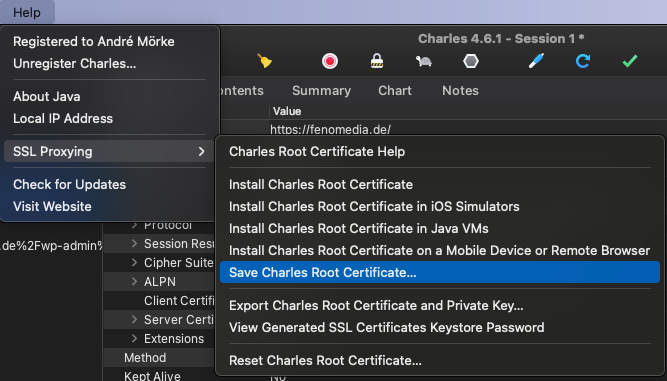
Wichtig: Wenn das Zertifikat abgelaufen Seitn sollte, muss man über „Reset Charles Root Certificate…“ im gleichen Menü ein neues erstellen und auf alle Clients aktualisieren!
Safari spielt Videos, welche man plain versucht auszugeben, nicht ab. Das scheint mit der Pufferung zu tun zu haben. Dafür funktioniert folgendes Skript:
$fp = fopen($filepath, "rb");
    $size = filesize($filepath);
    $length = $size;
    $start = 0;
    $end = $size - 1;
    header('Content-type: video/mp4');
    header("Accept-Ranges: 0-$length");
    if (isset($_SERVER['HTTP_RANGE'])) {
        $c_start = $start;
        $c_end = $end;
        list(, $range) = explode('=', $_SERVER['HTTP_RANGE'], 2);

        if (strpos($range, ',') !== false) {
            header('HTTP/1.1 416 Requested Range Not Satisfiable');
            header("Content-Range: bytes $start-$end/$size");
            exit;
        }

        if ($range == '-') {
            $c_start = $size - substr($range, 1);
        } else {
            $range = explode('-', $range);
            $c_start = $range[0];
            $c_end = (isset($range[1]) && is_numeric($range[1])) ? $range[1] : $size;
        }

        $c_end = ($c_end > $end) ? $end : $c_end;

        if ($c_start > $c_end || $c_start > $size - 1 || $c_end >= $size) {
            header('HTTP/1.1 416 Requested Range Not Satisfiable');
            header("Content-Range: bytes $start-$end/$size");
            exit;
        }

        $start = $c_start;
        $end = $c_end;
        $length = $end - $start + 1;
        fseek($fp, $start);
        header('HTTP/1.1 206 Partial Content');
    }

    header("Content-Range: bytes $start-$end/$size");
    header("Content-Length: ".$length);

    $buffer = 1024 * 8;

    while(!feof($fp) && ($p = ftell($fp)) <= $end) {
        if ($p + $buffer > $end) {
            $buffer = $end - $p + 1;
        }
        set_time_limit(0);
        echo fread($fp, $buffer);
        flush();
    }

    fclose($fp);
exit;Code-Sprache: PHP (php)Über die Haversine Formel kann man sich für latitude und longitude Werte die Entfernung per SQL ausrechnen lassen:
SELECT *, (((acos(sin(([LATITUDE]*pi()/180)) * sin((`lat`*pi()/180)) + cos(([LATITUDE]*pi()/180)) * cos((`lat`*pi()/180)) * cos((([LONGITUDE]- `lng`) * pi()/180)))) * 180/pi()) * 60 * 1.1515 * 1.609344) as distance
FROM [TABLE] HAVING distance<4 ORDER BY distance[mysqld] add line:default-authentication-plugin=mysql_native_passwordmysql -u root -p, then inside shell execute this command (replacing [password] with your actual password):ALTER USER 'root'@'localhost' IDENTIFIED WITH mysql_native_password BY '[password]';exit and run brew services restart mysql.
Standard ist Port 8000. Dieser wird im WLAN default geblockt. Niedrigerer Port
--port 3000
hilft.
php artisan serve --port=80 --host=192.168.1.5

und dann auf Device:
192.168.1.5:80Probleme auf dem Mac mit dem Filesystem speziell Netzlaufwerke, erwirken diese Fehlermeldung. 2 Möglichkeiten dazu: